SG90 servos can be sourced very cheaply on Ebay, and cost considerably less than points motors. A simple installation is shown below, where the servo is mounted below the layout board.
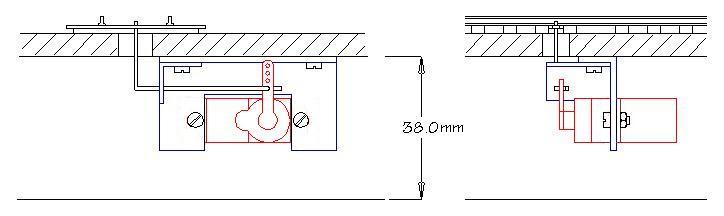
The servo mounting bracket is fabricated from two pieces of aluminium angle, sourced from B & Q, which is screwed to the underside of the board. The linkage is 20swg piano wire (about 2mm diameter) which passes through a slot in the board and engages the centre hole in the tie bar. The piano wire is sufficiently flexible to act as a spring to hold the closure rails in position.
The throw of the servo must be set to provide just enough movement to position the point blades
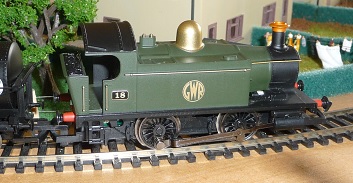
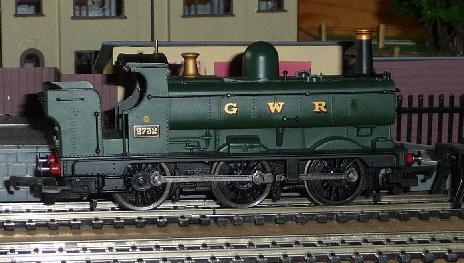
Fitting Sound to Hornby OO gauge 0-6-0 GWR 2721 Class
Fitting
sound to locomotives with tenders is relatively easy. Recent models
usually already have mountings for a speaker, and are fitted with an 8
pin dcc socket, so it becomes a "plug and play" exercise.
Older models may have a dcc socket, but no provision for a speaker, so a plasticard mounting has to be fabricated. Older still, and not dcc ready, require rewiring, fitting a socket, and speaker mounting..
Models of tank engines provide more of a challenge . Often there is not enough room for an 8 pin dcc socket, let alone a speaker inside, so some rearrangment of the insides in necessary.
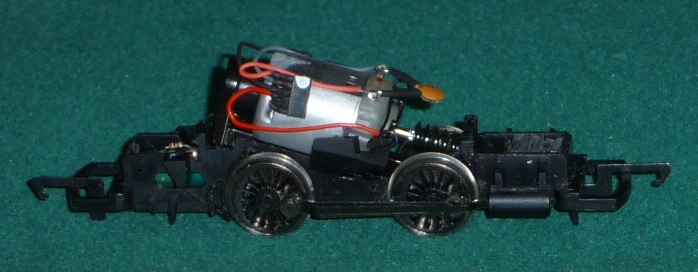
While the boxy shape of the 2721 class might appear to have room inside, the side tanks are filled with ballast weights, which are difficult to dislodge, and there is not much differece in room inside between this and Hornby's 0-4-0 models.
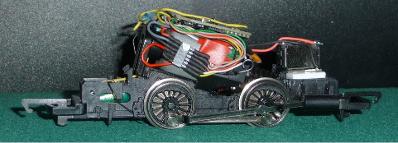
However, there is just enough room to fit an NMRA 6 pin dcc socket and a sugarcube speaker, with enough space left for a 1000 microfarad "stay alive" capacitor, without having to modify the body shell or chassis.
The first step was to rewire the locomotive with a 6-pin dcc socket. This is a bit fiddly, as the pin spacing is only 1.27mm. The socket sits on top of the motor, as far back as it will comfortably go.
The hornby sound decoders are fitted with 8 pin connectors, so this will also need changing. (The socket can be purchased as MULTICOMP PRO MC-SVT1-S06-G and the plug as MULTICOMP PRO MC-HVT1-S06-G from CPC.
Plugs and sockets with leads attached can be found on Ebay)
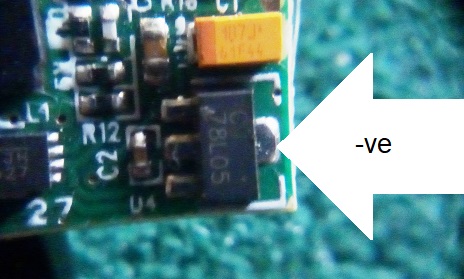
The "stay alive" system requires a 0volt connection. This needs another wire fitting to the circuit board. The easiest place to connect is to the large pin on the 78L05 regulator chip, which is conveniently situated at the end of the board.
I obtained a 15 x 11mm ESU sugarcube speaker kit from "Roads and Rails", which came with an ABS enclosure kit of 3 spacers and a back plate. I opted for the thinnest installed package, with no spacers, and glued the back plate in position. ( It is very important to seal the backplate in position, otherwise you get very poor sound output.) The sound output from the tiny speaker is virtually the same as from the one supplied with the decoder board.
I made a frame from 0.5mm plasticard to hold the speaker, facing downwards, leaving a 2 to 3mm gap between it and the loco chassis when it was installed.
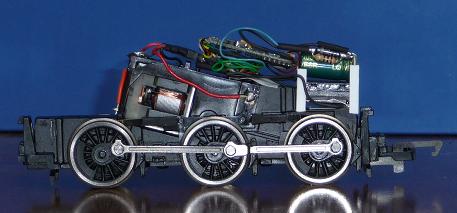
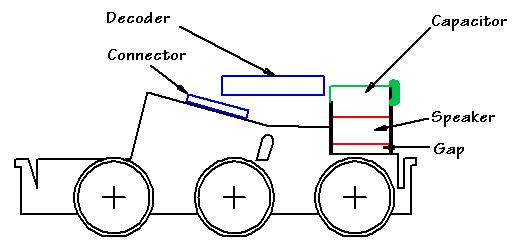
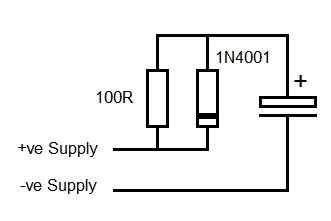
The end plates are glued to the speaker frame and the "Stay Alive" capacitor sits on the backplate of the speaker.
This is best fitted with a plug/socket connection so it can be disconnected when programming the decoder. (If fitted, a "Stay Alive" capacitor interferes with the "Acknowledge" signal which the decoder sends while being programmed.) Stay Alive capacitors are discussed below.